Why Aluminum Is the Smart Choice for Commercial Canopies, and What to Specify
General contractors, architects, developers and facility managers all weigh the same things when choosing a canopy material: looks, structure, upkeep, schedule and long-term cost. Aluminum shows up on commercial projects for good reason. But “aluminum is better” shouldn’t be taken on faith.
This article lays out the evidence. It explains where aluminum’s advantages come from, where it needs careful detailing, and what to have ready when you request a quote.
Sharchs has built aluminum canopies since 2011, from early coordination with architects through final installation. The guidance below comes from that work and is backed by published industry sources.
1. Corrosion Resistance Built Into the Metal
Steel’s biggest weakness outdoors is rust. Once the coating on a steel canopy is chipped or scratched, moisture reaches the iron. Corrosion can then spread under the paint.
Aluminum behaves differently. When bare aluminum meets air, it forms a thin natural oxide layer. That layer is clear, tough and protects the metal from corrosion (GSA Historic Preservation). The film re-forms almost at once if it is damaged. That makes aluminum less prone than steel to structural corrosion, even near water and salt air (Lysaght white paper).
What this means for a canopy: a scratch from a delivery truck, a ladder or a pressure washer does not start rust that spreads. The finish still matters for looks, but the metal under it protects itself.
2. Light Weight Means Less Load on the Building
Aluminum weighs about one-third as much as steel for the same volume (BeamChart). On a wall-mounted canopy, that lower dead load has practical benefits:
- Less demand on the wall and its anchors. This matters most on existing buildings, where the wall’s capacity may be limited or unknown.
- Easier handling and installation. Lighter assemblies are easier to lift, place and fasten. That can mean less equipment on site.
- Lower freight weight for prefabricated assemblies.
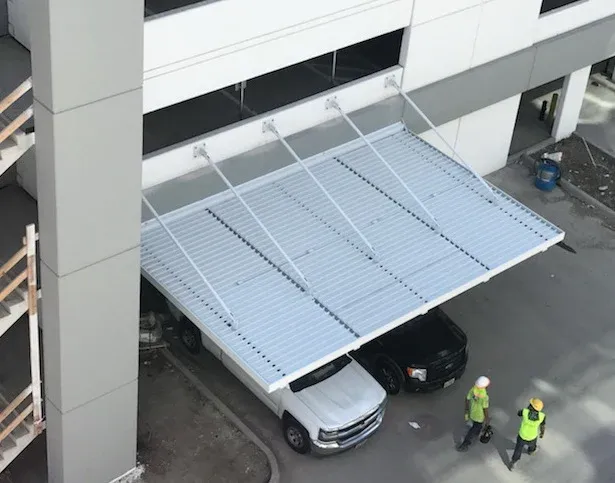
The honest trade-off: steel is stronger and about three times stiffer than aluminum (BeamChart). An aluminum canopy can’t just copy steel member sizes. It has to be designed for deflection as well as strength, often with deeper sections or shorter spans. A properly engineered aluminum canopy accounts for this from the start. For a full comparison, see steel vs. aluminum sunshades.
3. Designed to a Recognized Engineering Standard
Aluminum structures aren’t guesswork. The Aluminum Association’s Aluminum Design Manual (2020 edition) sets the rules for the strength of aluminum structural members and connections (Aluminum Association). It covers members, connections, welded and unwelded alloys, and fasteners (ANSI Webstore). The manual is also published in the ICC code library (ICC).
Why this matters for buyers: an aluminum canopy can be engineered and documented to the same standard of care as other structural parts of the project. That includes design wind loads, snow loads where they apply, and the attachment to the actual wall. Site-specific engineering is available when a project needs it. If you need stamped calculations, tell us up front.
4. Finish Options That Last: The Industry’s 5-Year and 10-Year Standards
Aluminum takes high-performance architectural finishes very well, but only if the right finish is specified for the exposure. The finish industry sets two common performance standards for paint and powder coat on architectural aluminum: a 5-year standard and a 10-year standard.
The 5-year standard limits gloss and color loss over five years of outdoor weathering. The 10-year standard requires greater sunlight and corrosion resistance (Products Finishing). Both are tested with outdoor exposure in South Florida, and the 10-year standard doubles the exposure period (Sundial Powder Coating).
Side-by-Side Comparison
| Criterion | 5-Year Standard (High Performance) | 10-Year Standard (Superior Performance) |
|---|---|---|
| South Florida outdoor exposure | 5 years (Products Finishing) | 10 years (Products Finishing) |
| Color change | Max. 5 ΔE after 5 years (UC Powder) | Max. 5 ΔE after 10 years (Sundial Powder Coating) |
| Gloss retention | 30% after 5 years (UC Powder) | At least 50% after 10 years (Sundial Powder Coating) |
| Chalk rating | 8 after 5 years (UC Powder) | No less than 8 after 10 years (Sundial Powder Coating) |
| Salt spray (ASTM B117), example powder product | 3,000 hours (Sherwin-Williams Powdura) | 4,000 hours (Sherwin-Williams Powdura) |
| Humidity (ASTM D2247), example powder product | 3,000 hours (Sherwin-Williams Powdura) | 4,000 hours (Sherwin-Williams Powdura) |
| Typical chemistry | TGIC polyester or “super-durable” powder (Products Finishing) | Fluoropolymers such as PVDF or FEVE (Products Finishing) |
| Typical uses | Window and door frames, railings, fencing, outdoor fixtures (Products Finishing) | Monumental building products and cladding (Products Finishing) |
Exact test values depend on the edition of the standard. Specifiers should name the edition the project requires and not mix values from different revisions (Professional Powder Coating).
How to Choose
- The 5-year standard is a strong fit for many commercial canopies, sunshades and screens in moderate exposure. It works well where cost matters and the color is not very sensitive to fading.
- The 10-year standard is the better choice for long-term color and gloss, highly visible brand colors, intense sun, coastal or industrial air, and owners who expect the finish to look new for longer.
- Pretreatment matters as much as the coating. Architectural aluminum needs a chrome, chromate or high-quality non-chrome conversion coating for good adhesion and corrosion resistance (Products Finishing).
Anodizing as an Alternative
Anodizing grows a thicker, controlled oxide layer instead of applying a coating. For architectural work it is specified as Class I (minimum 0.7 mil) or Class II (minimum 0.4 mil) (BNP Media continuing education). It suits projects that want a metallic look, but the color range is narrower than with painted finishes.
Finishes Available From Sharchs
Sharchs offers a full range of architectural finishes, so the finish can match the project’s exposure, budget and design:
| Finish | Color Options |
|---|---|
| Powder coat, 5-year industry standard | Standard colors, premium colors, or custom color match |
| Powder coat, 10-year industry standard | Standard colors, premium colors, or custom color match |
| Kynar (PVDF) | Standard colors, with custom colors available |
| Anodized | Clear or bronze |
Kynar 500 resins are widely known across the architectural metals industry for durability in demanding settings (Metal Alliance). Kynar, anodized and custom-matched colors cost more and can add time to the schedule, so we flag both at bid. Start with our standard color chart (PDF), and see canopy colors and finishes for more. If your spec names a finish system, a coating maker or an edition of the standard, include it with your bid documents so the quote matches it exactly.
5. Low Maintenance Over the Service Life
Aluminum doesn’t rust, so it doesn’t need the cycle of scraping, priming and repainting that exposed steel often does. With a finish that suits the exposure, routine care usually means cleaning now and then and checking fasteners, sealants and drainage. See how to maintain your aluminum canopy.
Actual service life depends on the environment, the finish and the detailing. Be wary of any blanket lifespan claim, from any supplier.
6. A Sustainable Material Choice
Aluminum is 100% recyclable and can be recycled again and again without losing its value (Aluminum Association). Making recycled aluminum takes only about 5% of the energy needed to produce new metal (Aluminum Association). Nearly 75% of all aluminum ever produced is still in use today (Aluminum Association). For owners and design teams with sustainability goals, that is a real point in aluminum’s favor.
7. Where to Be Careful
No material is right for every condition. A sound aluminum canopy design addresses these points:
- Galvanic corrosion. Aluminum is less noble than steel, copper, lead, stainless steel and bronze (APTI). Where aluminum touches other metals, such as steel embeds, copper flashing or some fasteners, the connection needs isolation and compatible hardware.
- Chlorides and pollutants. Aluminum can corrode over time when exposed to sulfates and chlorine. Examples are acid rain in heavily polluted cities and salt spray along the coast (Glass Magazine). In these settings, the choice of finish matters even more.
- Stiffness and long spans. Aluminum is less stiff than steel. Very long projections or clear spans may need deeper members, more supports or a hybrid structure.
- Wall capacity. A light canopy still needs a sound attachment. Hollow masonry, EIFS, metal studs and other existing walls need to be checked before the attachment is designed.
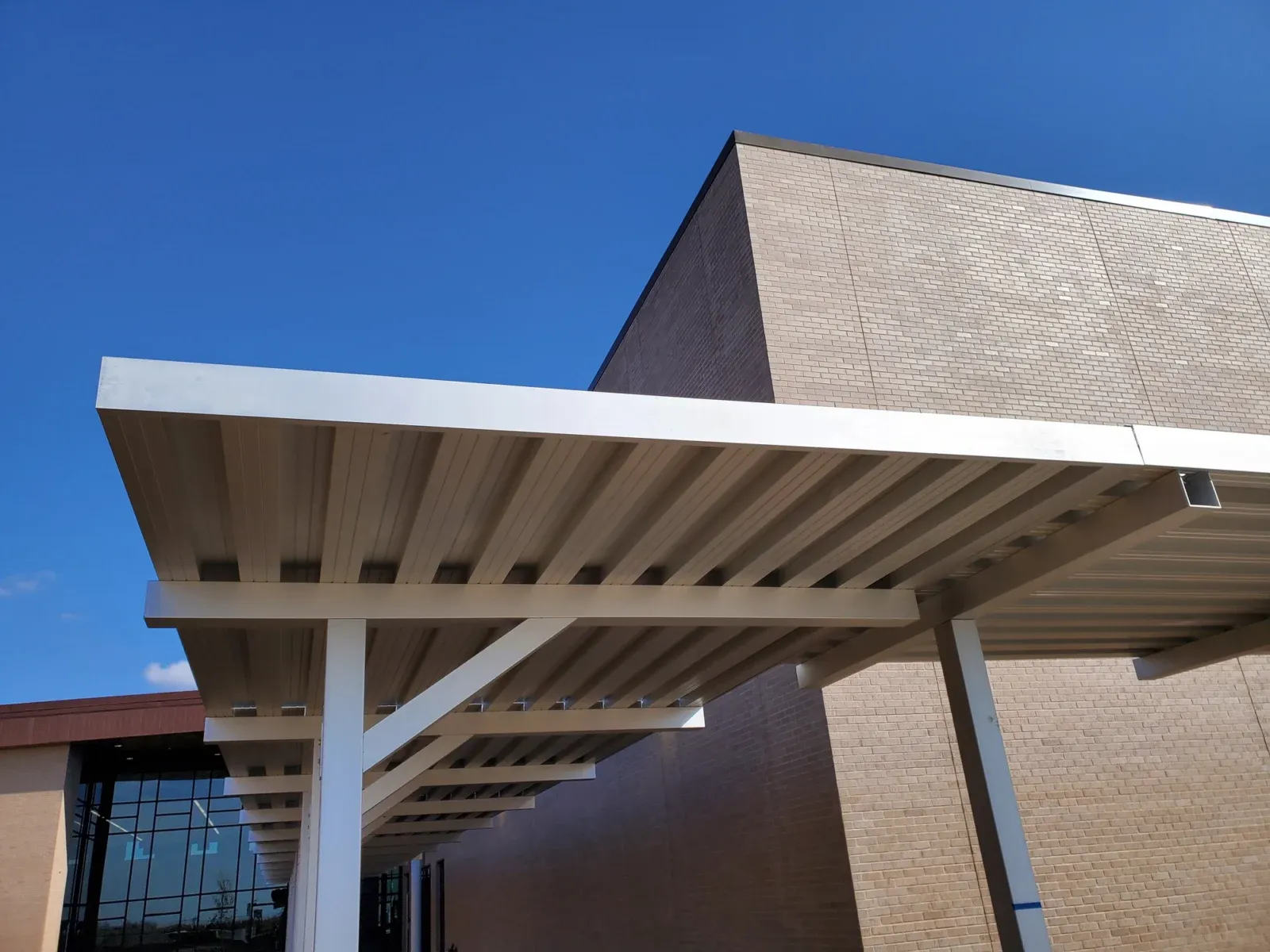
8. The Same Logic Applies Across Product Lines
The advantages and cautions above also apply to related architectural aluminum products:
- Sunshades: lighter projecting loads on curtain walls and storefronts.
- Trellises: long exposed runs where corrosion and finish durability are easy to see.
- Bahama shades: operable or fixed louvers where low weight helps.
- HVAC equipment screens: rooftop exposure to sun and weather, where keeping roof load down matters.
9. What to Send for an Accurate Quote
A canopy quote is only as good as the information behind it. To get a price that won’t change at submittal, send as much of the following as you can:
- Plans and elevations showing canopy locations, plus any architectural details or sections.
- Dimensions: projection, width, mounting height and quantity of each type.
- Wall type at each attachment point, such as concrete, CMU (grouted or hollow), steel, wood or metal stud.
- Project location and design criteria: design wind speed and exposure category, snow load where it applies, and the governing code edition.
- Finish: powder coat to the 5-year or 10-year standard, Kynar, or anodized (clear or bronze), plus the color: a standard color, a premium color, or a color-match sample.
- Style: hanger rod or cantilevered, post-supported, louvered or solid deck.
- Drainage: gutters, scuppers or downspouts.
- Built-in items: lighting, signs or conduit.
- Engineering responsibility: whether delegated design with stamped calculations is required, and who provides it.
- Scope split: supply only (shipped fully fabricated) or supply and install, plus the project address and who provides the blocking or embeds.
- Schedule: submittal deadline and required on-site date.
Missing items aren’t a reason to wait. Send what you have, and the open questions can be listed as clarifications or RFIs. We bid within 2 business days, submittals take 7 to 10 business days, and typical production is 8 to 10 weeks after approval. For more on bid timing, read how GCs get a canopy bid within 2 business days.
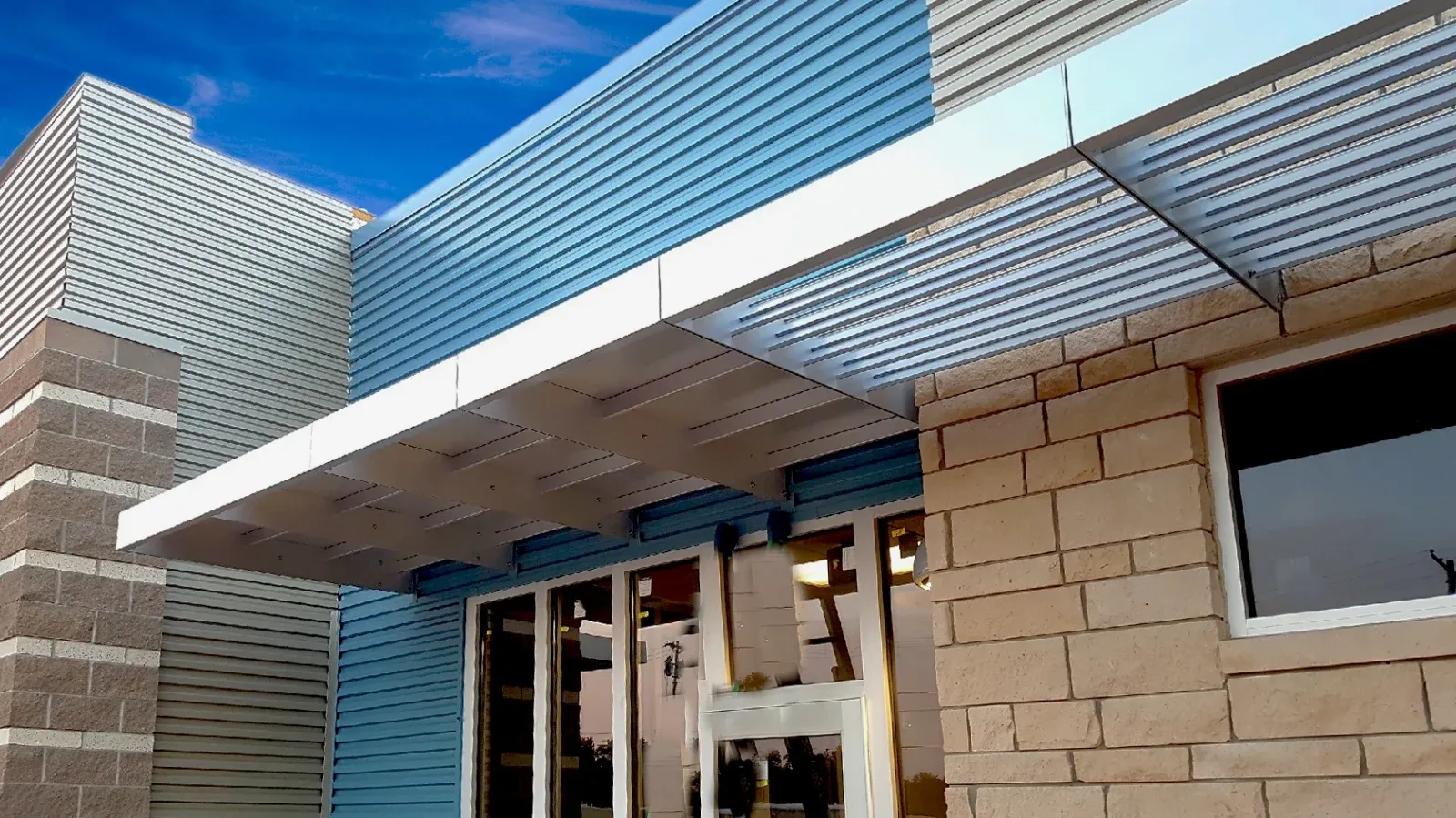
Talk to Sharchs About Your Project
Sharchs has designed and built architectural aluminum since 2011, from architect coordination through final installation. We offer powder coat to the industry’s 5-year and 10-year standards, Kynar and anodized finishes. We install in Texas, Oklahoma, Louisiana, Arkansas and New Mexico, and ship fully fabricated products anywhere in the U.S.
Send your plans and the details listed above, and we’ll help you sort out what’s needed for an accurate quote. Request an aluminum canopy quote or contact Sharchs.
Frequently Asked Questions
Does aluminum rust?
No. Rust is iron oxide. Aluminum forms its own protective oxide layer, and that layer re-forms quickly if it is scratched.
Is aluminum strong enough for a commercial canopy?
Yes, when it is engineered correctly. Aluminum structures are designed to the Aluminum Association's Aluminum Design Manual, with member sizes chosen to control deflection as well as strength.
Should I specify the 5-year or the 10-year finish standard?
The finish industry's 5-year standard suits many canopies in moderate exposure. Choose the 10-year standard for intense sun, coastal or industrial air, branded colors, or when the owner expects the finish to look new for longer.
What finishes does Sharchs offer?
Powder coat to the industry's 5-year or 10-year standard in standard, premium or color-matched colors; Kynar (PVDF) in standard or custom colors; and clear or bronze anodizing. Kynar, anodized and custom colors cost more and can add time to the schedule. See canopy colors and finishes.
Where does Sharchs install?
Sharchs installs in Texas, Oklahoma, Louisiana, Arkansas and New Mexico, and ships fully fabricated products anywhere in the U.S.
How long does a canopy quote and order take?
Send your plans and we bid within 2 business days. Submittals take 7 to 10 business days, and typical production is 8 to 10 weeks after approval. Expedited production is available.
Is aluminum a sustainable choice?
Yes. Aluminum is 100% recyclable, and recycled aluminum takes about 5% of the energy needed to make new metal.