
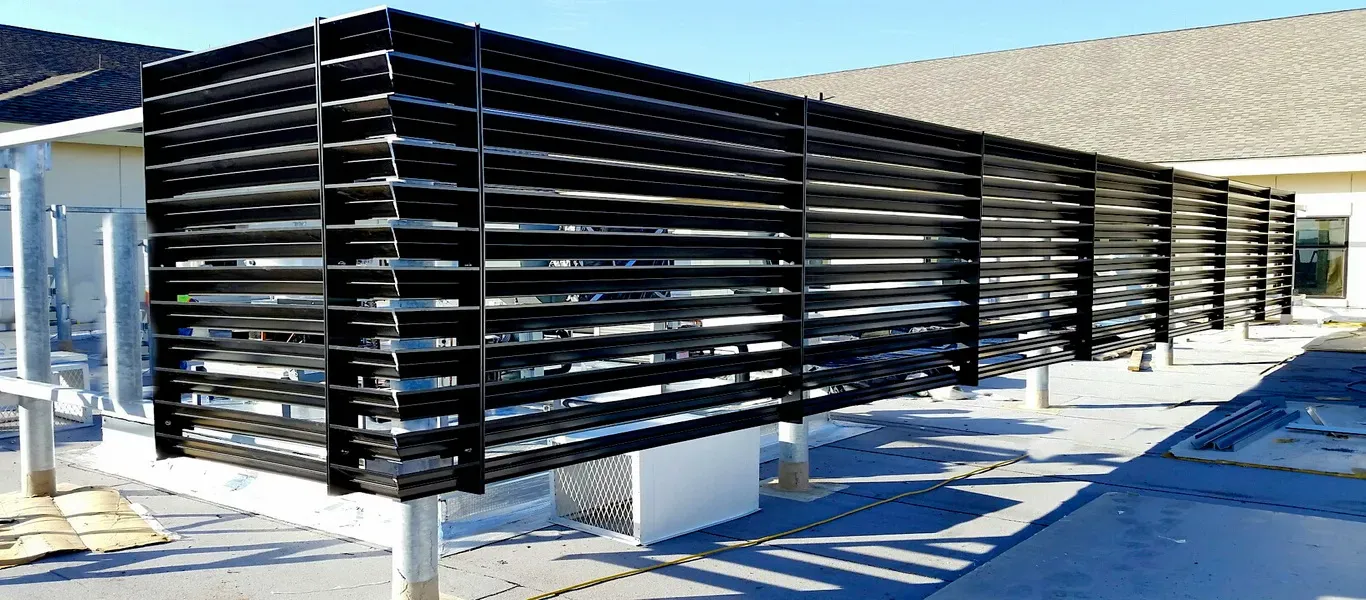
Understanding Aluminum Architectural Louvers
Modern commercial buildings must accomplish much more than simply providing usable space. Architects and developers are challenged to create structures that are visually appealing, energy-efficient, and capable of supporting complex mechanical systems. One architectural component that plays a significant role in achieving these goals is the use of aluminum architectural louvers.
Often integrated into building facades, mechanical rooms, parking structures, and equipment enclosures, architectural louvers provide essential ventilation while contributing to the overall appearance of a building.
For architects, contractors, developers, and property managers, understanding the key benefits and applications of architectural louvers can make it easier to select the right system for your commercial construction project.
The Important Role of Ventilation in Commercial Buildings
Every commercial property requires proper airflow to support mechanical equipment and maintain healthy building operations. HVAC systems, generators, electrical rooms, and other critical infrastructure depend on adequate ventilation to perform efficiently and safely.
Aluminum architectural louvers allow air to move freely through designated openings while helping to control the intrusion of rain, debris, and unwanted elements. This balance is critical for maintaining equipment performance without compromising the integrity of the building envelope.
By supporting airflow in key areas, louvers contribute to the overall functionality and reliability of modern commercial facilities.
Enhancing Building Appearance Through Thoughtful Design
Architectural features are no longer expected to be purely functional. Today’s building owners and designers seek solutions that enhance visual appeal while meeting operational requirements.
Aluminum architectural louvers can be customized to complement virtually any architectural style. Rather than appearing as an industrial necessity, they can become an integrated design element that contributes to the building’s aesthetic character.
Architects frequently use louvers to create visual rhythm across a facade, conceal mechanical systems, and maintain a consistent appearance throughout a project. With a variety of blade styles, finishes, and configurations available, louvers can be tailored to support both contemporary and traditional designs.
Concealing Mechanical Equipment Without Sacrificing Performance
Mechanical equipment is essential to commercial operations, but it is rarely something building owners want prominently displayed. Rooftop units, generators, cooling systems, and utility equipment can detract from an otherwise attractive building design.
Aluminum architectural louvers offer an effective solution by screening these systems from view while preserving the airflow necessary for proper operation. This allows architects to maintain clean sightlines and polished building exteriors without interfering with equipment performance.
The result is a more professional and cohesive appearance that benefits both property owners and occupants.
Why Aluminum Is Ideal for Architectural Louvers
Exterior building products must be able to withstand years of environmental exposure while maintaining their appearance and functionality. Aluminum has become one of the most trusted materials in commercial construction because of its durability and resistance to corrosion.
Unlike materials that may rust, crack, or deteriorate over time, aluminum performs exceptionally well in demanding conditions. It remains stable through changing temperatures, precipitation, and prolonged UV exposure, making it a dependable choice for projects across diverse climates.
Additionally, aluminum’s lightweight properties provide greater design flexibility while reducing structural demands on the building.
Supporting Sustainable Building Design
Sustainability continues to influence commercial construction decisions throughout the industry. Building owners are increasingly seeking solutions that contribute to energy efficiency and long-term environmental performance.
Aluminum architectural louvers can support these objectives by helping regulate airflow and contributing to efficient building operation. Many aluminum products are also manufactured using recyclable materials, aligning with broader sustainability initiatives within the construction industry.
When incorporated into a well-designed building envelope strategy, louvers can play an important role in supporting modern performance standards.
Applications Across Commercial Industries
The versatility of aluminum architectural louvers makes them suitable for a wide range of applications. Office buildings use them to conceal rooftop equipment and ventilate mechanical rooms. Healthcare facilities rely on them to support critical building systems while maintaining a professional appearance. Educational campuses, government buildings, hospitality properties, and industrial facilities all benefit from the combination of performance and aesthetics that louvers provide.
Their adaptability allows architects and contractors to solve functional challenges without compromising the overall design vision of the project.
Partner with Sharchs on Your Next Equipment Screen System
Sharchs Corporation esigns and fabricates precision-engineered aluminum equipment screens tailored to demanding commercial building specifications. Working directly with design teams, developers, and trade contractors, we ensure every screening layout satisfies structural, ventilation, and visual requirements.
By engaging with Sharchs early in the design and estimation process, you gain access to expert technical insight that streamlines manufacturing and site integration.
Ready to talk about custom architectural screenings for your building? Contact Sharchs to discuss your specifications and find the right aluminum equipment screen solution.
The Core Functions of Louver Systems in Commercial Projects
In commercial applications, louvers are rarely installed for aesthetics alone. They are engineered to solve specific physical and environmental challenges across the building envelope.
1. Ventilation and HVAC Optimization
Commercial structures house massive heating, ventilation, and air conditioning (HVAC) systems that require high volumes of fresh air intake and exhaust to maintain indoor air quality. Louvers act as the primary intake and exhaust grilles on the building’s exterior. They allow the mechanical systems to “breathe” efficiently, preventing the static pressure buildup that forces HVAC motors to work harder and consume more energy.
2. Mechanical Equipment Screening
Rooftops and ground-level service yards are frequently crowded with unsightly chillers, cooling towers, and backup generators. Municipal building codes often mandate that these units be hidden from public view. Architectural louvered equipment screens provide an elegant solution. They create a continuous visual barrier that conceals the equipment while maintaining the strict, unimpeded airflow parameters required to prevent the machinery from overheating.
3. Passive Solar Control and Glare Reduction
When mounted horizontally over storefront windows or vertically along a glazed curtain wall, louvers function as highly effective sun control devices. By blocking high-angle summer sun while allowing low-angle winter light to penetrate, sun-shading louvers mitigate solar heat gain. This actively lowers the building’s peak cooling load, reduces interior glare for occupants, and protects interior finishes from ultraviolet (UV) degradation.
Last updated
Frequently asked questions
What are aluminum architectural louvers?
Architectural louvers are angled blade systems installed on commercial building facades, mechanical rooms, and equipment enclosures to allow essential ventilation while shielding the interior and equipment from rain, debris, and direct view.
How do louvers improve commercial building energy efficiency?
By promoting natural airflow and continuous ventilation, louvers help reduce heat accumulation around mechanical equipment and within building envelopes, allowing HVAC and power systems to run more efficiently.
Can architectural louvers be customized for specific designs?
Yes. Louvers can be customized in a wide variety of blade profiles, frame depths, finishes, and colors to match specific architectural aesthetics, structural dimensions, and airflow requirements.
What commercial applications are best suited for louvers?
They are widely used in office buildings, healthcare facilities, educational campuses, industrial sites, parking structures, and retail centers to conceal HVAC systems, generators, and utility rooms without restricting airflow.
What is the difference between a louver and a damper?
While they look similar, their purposes are different. A louver features fixed or semi-adjustable blades designed primarily to allow continuous airflow while shedding rain. A damper is a mechanical device with movable blades used to actively regulate, throttle, or completely shut off airflow within an HVAC duct or wall opening.
Can architectural louvers prevent water from entering a building?
Standard architectural louvers are designed to deflect the vast majority of cascading rainwater. However, for severe weather environments, specialized “drainable” or “storm-resistant” louvers utilize secondary gutter channels built directly into the individual blades to capture and drain wind-driven rain before it can penetrate the interior building envelope.
What are the standard lead times for custom aluminum louvers?
Lead times vary by manufacturer, but foreign fabrication often introduces multi-month delays. Sourcing from a domestic supplier like Sharchs typically streamlines the timeline to a predictable eight-to-10-week window from finalized engineering drawings to job-site delivery.