Which Architectural Shade System Is Right for Your Business?
Selecting an architectural shade system for a commercial property involves more than picking a style that appeals to you. Interior areas may struggle to control heat gain or harsh glare, while entrances often need added protection from sun, wind or rain. At the same time, your chosen solution must complement the building’s design and respect budget and schedule constraints. Balancing these factors makes the decision complex.
This guide will help you select the best-fitting commercial architectural shade system for your business, based on orientation, function and long-term performance.
Start With the Decision Criteria
Determining your must-haves from the beginning keeps the process grounded in real needs rather than assumptions.
Define the Business Objective
Every shade system solves a problem. For example, on some projects, the primary concern is reducing heat gain to stabilize interior temperatures and lower cooling demand. Glare control is a higher priority in offices, labs or other spaces where people work near windows for long periods.
Most projects resolve at least one of these three concerns.
- Solar performance: Prioritizes heat and glare reduction at the building exterior.
- Occupant comfort: Emphasizes weather protection and usability at ground level.
- Visual or branding: Uses shade elements to shape identity and guide movement.
Assess the Building and Site Conditions
Once you’ve established a specific objective, use the building to inform most of your decision-making. Orientation, glazing and local climate all influence how effective a shade system will be over time.
For example, buildings with heavy south-facing glazing typically benefit from horizontal shading that blocks high summer sun while allowing softer winter light. Understand these realities from the start to avoid redesigns later.
Confirm Project Constraints
Budget, schedule and ongoing operations all shape what is possible. Some systems offer excellent performance but introduce complexity that doesn’t align with how you plan to use or maintain the building. Address these constraints to keep expectations realistic.
Sunshade Types
Each sunshade type responds to sunlight differently, and understanding those distinctions will let you avoid mismatches between expectations and performance.
1. Horizontal Aluminum Sunshades
When installed in the appropriate location, horizontal aluminum sunshades are effective, durable and visually clean. These systems project outward to intercept sunlight coming from higher angles in the sky. Aluminum sunshades perform best on south-facing elevations, where the sun follows a predictable path throughout the day and year.
2. Vertical Fins or Brise Soleil
On east- and west-facing buildings, sunlight enters at a low angle. Vertical fins, oriented perpendicular to the building’s exterior, shield against low-angle glare. These features are particularly valuable in office buildings, educational facilities and health care environments where visual comfort matters throughout the day.
3. Architectural Louvers and Sun Control Devices
Louvers manage sunlight while still allowing airflow, visibility or partial transparency. Consider installing them in areas where full shading is not the goal, but uncontrolled exposure would still create discomfort.
4. Trellises and Architectural Screens
Trellises and screens create filtered shade and visual separation, making them suitable for walkways, courtyards and transitional spaces around a building. In addition, they can support outdoor shade structures with branding, improve wayfinding or soften the transition between indoor and outdoor spaces.
Canopy vs. Sunshade
Sunshades manage sunlight at the building envelope, while canopies protect the people and activity below. This distinction is critical because many teams encounter both options while researching the different types of commercial awnings, without realizing that these systems solve very different problems.
When a Canopy Works Better for a Building
Canopies primarily provide shelter. They sit above walkways, entrances and service areas and shield passersby from rain, snow and falling debris. On many projects, they also serve as visual markers, helping visitors understand where to enter and park.
A canopy makes sense if comfort at ground level is your primary concern. Entry doors, loading docks, pickup zones and pedestrian paths all benefit from overhead protection that keeps people dry and can improve safety.
When a Sunshade Works Better for a Building
Sunshades control how sunlight interacts with the building. Installing them above or in front of glazing reduces heat gain and glare. Sunshades are most effective on upper-story windows and glass-heavy buildings, where solar exposure directly affects interior comfort and energy use.
Hybrid Solutions
Many commercial buildings benefit from combining canopies and sunshades. A sensible strategy is to use canopies at the ground level, where people interact with the building, and sunshades on upper levels, where glazing and solar exposure dominate. Hybrid solutions work exceptionally well on larger sites or multistory buildings, where a single system would struggle to meet every functional requirement.
Fixed vs. Operable Systems
The choice between a fixed and an operable system depends on long-term performance, maintenance expectations and the level of complexity a project can realistically support.
Fixed Shade Systems
Fixed shades address specific solar angles, wind loads and environmental conditions. Once installed, they remain in place for the life of the building. With no moving parts, fixed systems require very little ongoing attention beyond routine inspection and cleaning.
This reliability is vital for industrial and commercial facilities with limited maintenance resources. Fixed systems are also extremely durable, with aluminum components lasting for decades
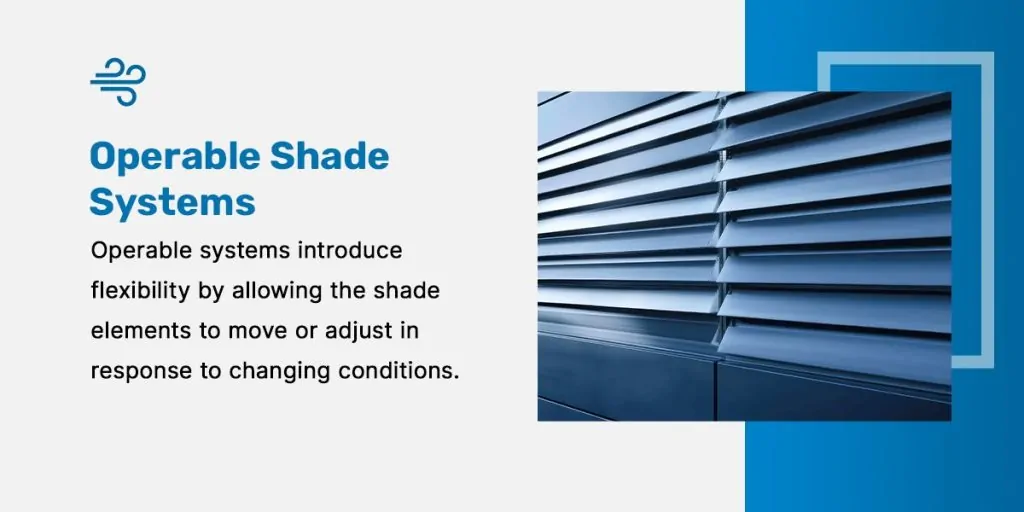
Operable Shade Systems
Operable systems introduce flexibility by allowing the shade elements to move or adjust in response to changing conditions. This solution relies on motors, controls and electrical connections, all of which add costs and ongoing maintenance requirements.
Practical Guidance for Facility Managers
For many commercial and industrial facilities, fixed systems offer the most balanced ROI. On the other hand, operable systems can be effective when flexibility is a core requirement. Understanding your building’s needs will guide your decision-making.
3 Engineering Fundamentals
Three principles keep shade systems performing successfully and predictably over time.
1. Structural Loads
Wind uplift can grow rapidly as the projection depth increases, especially on taller buildings or open sites. Snow accumulation can also concentrate near building exteriors, sometimes exceeding what designers expect based solely on roof conditions. Seismic considerations add another layer in active regions. Connections often need to allow for controlled movement without transferring stress back into the building envelope. Addressing these factors early allows correct sizing.
2. Attachment Strategy
Steel structures typically allow for more direct bolting or welding, which can simplify installation. Concrete and masonry often require through-bolts, embeds or supplemental backing to distribute loads safely. Shade attachments usually can’t rely on the glazing system alone and need to transfer loads back to the primary structure. Clear communication between the shade manufacturer and the general contractor prevents conflicts once installation begins.
3. Drainage and Corrosion Protection
Shade systems should shed water in a controlled way, directing runoff away from entrances, walkways and glazing. Material compatibility also matters. Aluminum in contact with steel or other dissimilar metals can experience corrosion if not properly isolated. Simple measures such as isolation pads, washers and coating can protect the system, particularly in coastal or industrial environments.
Finish Options and Durability
In commercial and industrial environments, finishes protect aluminum from environmental exposure while helping the system age gracefully alongside the building.
Common Aluminum Finish Options
Architectural aluminum shade systems are either powder-coated or anodized. Powder coating offers flexibility. It supports a broad range of colors, including custom matches, and provides good durability when specified to appropriate performance standards.
Anodizing creates a finish that chemically bonds to the aluminum surface, resulting in a metallic appearance with excellent hardness and wear resistance.
Selecting Finishes by Environment
Coastal environments introduce salt air that can accelerate corrosion if the finish is not durable enough. In these settings, high-performance coatings or architectural-grade anodizing protect the system.
Industrial and urban sites may expose shade systems to airborne chemicals, exhaust or heavy pollution. Finishes in these environments benefit from added resistance to staining and degradation.
Aesthetic and Performance Alignment
Lighter colors tend to reflect more sunlight, which can reduce heat buildup, but they may also increase glare in some locations. Darker finishes absorb more heat and can create a striking visual presence.
Projects must also align with established brand standards. Custom color matching allows shade systems to blend into the building or reinforce identity without appearing out of place.
Code Compliance and Submittals That Keep Projects Moving
In commercial construction, delays can come from incomplete submittals, unclear scope boundaries or engineering that doesn’t fully align with local requirements.
Code Compliance Essentials
Most jurisdictions base their requirements on the International Building Code and local amendments tied to climate and site conditions. The system must meet site-specific wind speeds and exposure categories, which vary based on building height, surrounding terrain and proximity to open areas. It’s also critical to obtain fire-related approvals and clarify project limitations.
Shop Drawings and Coordination
Architectural drawings show contractors how the system attaches, where tolerances matter and how the shade system interfaces with adjacent trades. On glass-heavy buildings, coordination between the glazier and shade installer must be precise to avoid confusion during construction.
Documentation for Approvals
A complete submittal package keeps reviews efficient and predictable. Typically, this documentation includes engineered calculations, product data, finish samples and installation requirements. Sharing it across the project team can reduce delays and support a smoother path from approval to installation.
Shade Structure Design and Construction
Planning from concept through installation ensures the shade system arrives on-site ready to perform, rather than requiring adjustments under pressure.
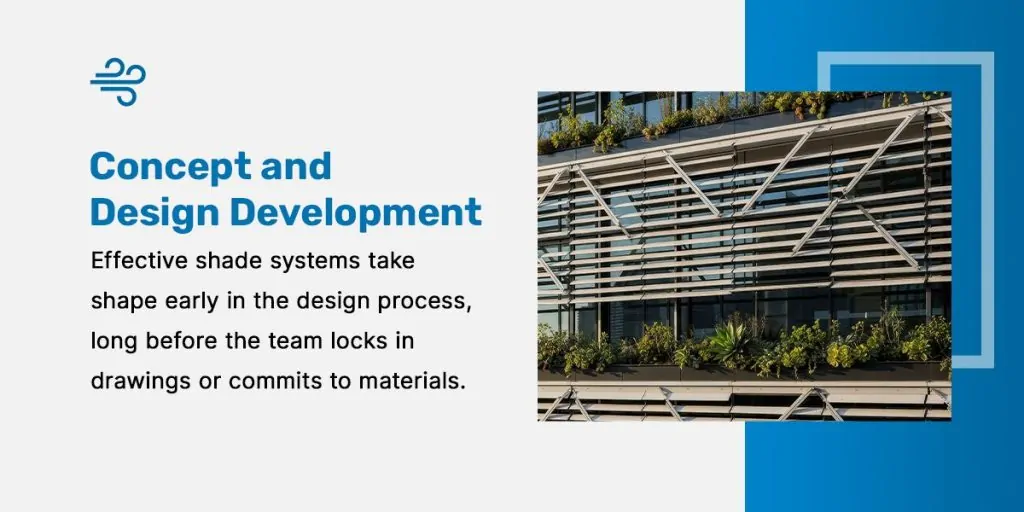
1. Concept and Design Development
Effective shade systems take shape early in the design process, long before the team locks in drawings or commits to materials. During this phase, designers evaluate sun angles, projection depth and spacing to confirm the system will perform as required.
Early design development also clarifies how the shade system relates to the rest of the building. Aligning with window modules and structural bays creates a more cohesive result and simplifies detailing downstream.
2. Fabrication and Fit-Up Planning
Factory-controlled fabrication consistently addresses material tolerances, connection details and section sizes, improving quality and reducing variability in the field.
Shipping considerations are part of this planning. Designing easy-to-transport components avoids oversized load requirements and can reduce handling risk.
3. Installation Sequencing
Contractors typically install shade systems after completing the building and glazing, but before final site work and landscaping. This sequencing protects finished surfaces and ensures access for lifts and scaffolding.
Communication around access, staging and tie-in points helps installers work efficiently and safely. Then, the installation becomes a straightforward process instead of a bottleneck at the end of the project.
Customization of Architectural Sunshades
Standard solutions work well for many commercial shade structures. However, buildings with unique geometry or integrated architectural elements often require a more tailored approach.
Signs You Need Custom Fabrication
Curved building exteriors, angled walls or unique layouts can make it challenging to apply standard profiles cleanly. Projects that call for integrated lighting, signage or unique visual elements also often require customized components.
Challenging attachment conditions are another indicator. When structural support is limited or irregular, custom brackets or connection strategies may be necessary to maintain performance without altering the building.
Design Assist Benefits for Architects and Contractors
Design assist becomes especially valuable as project complexity grows. Involving the manufacturer early gives the team a chance to identify and resolve potential issues long before they arise in the field. This collaboration also clarifies what the shop can fabricate, ship and install efficiently, ensuring the design intent stays realistic and buildable.
Value engineering often follows naturally. Small shifts — like choosing a standard tube size instead of a custom extrusion — maintain the visual concept while lowering cost and shortening lead times.
What to Provide for a Fast Start
Clear communication accelerates early feedback and keeps projects moving. Providing elevations, sections and structural details gives the design team a solid foundation to work from. Site photos add context that drawings alone may not capture, especially around access and attachment conditions.
Cost, Lead Time and Planning
Most of the technical decisions are already taking shape by the time a project reaches this stage. However, it often remains unclear how those choices affect cost, timing and project risk.
How Much Does It Cost to Build a Shade Structure?
There is no standard price for architectural shade systems, because it depends on your unique project complexity. Longer projects, heavier structural load, operable components and challenging attachment conditions all add time and effort during engineering and fabrication.
System type also matters. A straightforward fixed sunshade can be more cost-effective than a large canopy with extra features. In addition, custom profiles, unique geometries and specialty finishes can add expense, especially when they require nonstandard tooling or additional coordination.
An effective planning step is to request a rough order of magnitude. This cost estimating will provide approximate dimensions, target projections and basic load assumptions.
Lead Time Planning
Several overlapping phases influence the lead time.
- Engineering and approvals: Structural review, coordination and approval cycles can take longer than you expected if you provide incomplete information.
- Profile and finish availability: Standard profiles and finishes typically move faster than custom options.
- Design changes after release: Late adjustments can reset fabrication timelines and create delays.
- Coordination with the building exterior and structural trades: Misalignment here can lead to rework or stalled installation.
How Sharchs Corporation Supports Schedule and Performance
Sharchs Corporation approaches architectural shade systems as engineered building components rather than decorative add-ons. With more than 25 years of experience, U.S.-made aluminum systems and in-house engineering, we help project teams move from concept to fabrication with fewer handoffs and transparent communication. Our engineering support is often available within days, allowing teams to confirm loads and attachment strategies early.
Request a quote today to get an engineered shade system recommendation so your project stays aligned with performance goals, schedule and budget from the start.